
AI Implementation in Business: A Step-by-Step Journey from Zero to Results
 Ralf-Stiven Viru, CEO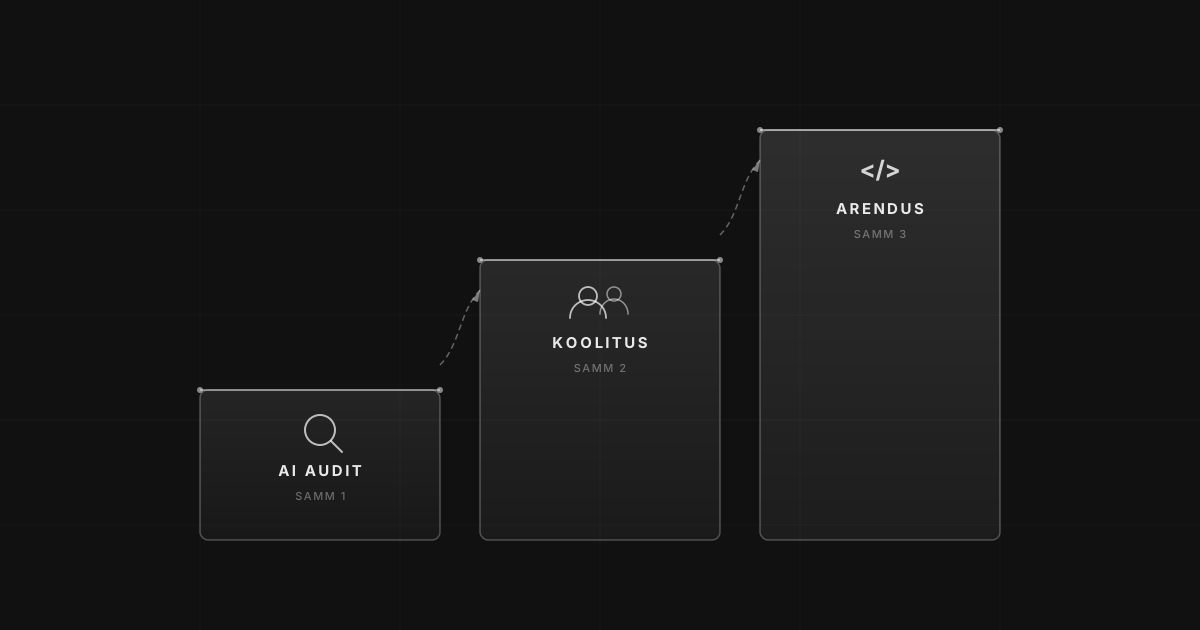
Seventy percent of AI projects fail. Not because the technology doesn't work. It does. They fail because companies skip the foundation, rush to build, and forget about the people who need to actually use the thing.
Implementation is where AI meets reality. It's the messy, human, organizational work of turning a pilot project into a functioning part of how your company operates. And it's where most companies need the most help.
This article is the playbook. A step-by-step guide to implementing AI in your business, based on real projects with Estonian companies, not theoretical frameworks from consulting firms that have never shipped anything.
Why 70% of AI Projects Fail
Before we talk about how to succeed, let's understand why most companies don't.
Failure mode #1: Technology without strategy. A company buys an enterprise AI tool because a vendor gave a great demo. Six months later, nobody uses it. The tool was a solution looking for a problem. Without a clear understanding of which business problems AI should solve, even the best technology collects dust.
Failure mode #2: Strategy without people. The leadership team creates a beautiful AI roadmap. It sits in a slide deck. Nobody on the ground changes how they work. Implementation without training and change management is just planning.
Failure mode #3: Pilot without scaling. A small team runs a successful experiment. Everyone is impressed. Then nothing happens. The pilot stays a pilot forever because nobody planned how to take it from experiment to standard operating procedure.
Failure mode #4: All at once. A company tries to transform everything simultaneously: customer service, sales, operations, finance. The organization can't absorb that much change. Everything moves slowly, budgets balloon, and the project gets killed at the next quarterly review.
The successful 30% share a common pattern: they follow a structured, phased approach. They start small, build capability, and scale what works. At AI Eesti, we've distilled this into three phases we call Map, Build, Adopt.
The Three Pillars: Map, Build, Adopt
Phase 1: Map (Kaardistame)
Every successful AI implementation starts with understanding, not technology. Before you write a single prompt or deploy a single tool, you need to know what you're working with.
What "Map" means in practice:
Process audit. Document every significant workflow in the company. Not the idealized version from your process manual, the real version. How do proposals actually get written? How do customer inquiries actually get handled? Where does information actually live?
We typically spend 2-3 weeks on this phase, interviewing team members across departments. The output is a detailed map of your operations with each process scored on AI readiness: repetitiveness, data availability, business impact, and implementation complexity.
Opportunity identification. From the process map, we identify specific opportunities. A typical 30-person company has 15-20 processes where AI can add value. Of those, 3-5 are quick wins that can be implemented within weeks.
Prioritization. Not all opportunities are equal. We rank them using a simple framework:
- Impact: How much time, money, or quality improvement is at stake?
- Feasibility: How hard is it to implement given your current tools and data?
- Risk: What happens if it goes wrong?
The result is a clear roadmap: what to do first, what to do next, and what to save for later.
What this looks like as a deliverable: You receive a document that says, in plain language: "Here are your top 5 AI opportunities, ranked by impact. Here's what each one costs to implement. Here's what you can expect in return. Here's the timeline. Here's what you need to get started."
This is what our AI audit delivers. It's the foundation that makes everything else possible.
Phase 2: Build (Ehitame)
With the map in hand, you know what to build. This phase is about creating working AI solutions, starting with the highest-impact, lowest-risk opportunities from Phase 1.
Week 1-2: Tool selection and setup
Based on the audit findings, we select the right tools for each use case. This isn't about picking the trendiest AI platform. It's about matching the tool to the task:
- Simple text tasks (emails, proposals, reports) → ChatGPT or Claude with custom instructions
- Data analysis and reporting → Built-in AI features in your existing tools, or custom dashboards
- Customer-facing interactions → Custom chatbots or AI-assisted communication tools
- Knowledge management → RAG-based systems connected to your internal documents
- Process automation → AI agents connected to your existing software stack
We configure the tools, set up integrations with your existing systems, and create the prompt libraries and templates your team will use daily.
Week 3-4: Pilot with a small team
The first implementation always starts with a small group, typically 3-5 people who are eager to try new things. This group serves two purposes: they test the solution in real conditions, and they become internal advocates who help the rest of the team adopt it later.
During the pilot, we track everything:
- Time saved per task
- Quality of AI-assisted output vs. previous output
- User satisfaction and adoption rate
- Edge cases and failure modes
- Needed adjustments to prompts, workflows, or integrations
Week 5-8: Iteration and expansion
Based on pilot feedback, we refine the solution. This usually means adjusting prompts, adding edge case handling, fixing integration issues, and simplifying workflows that turned out to be more complex than expected.
Then we expand to the broader team, one department at a time.
What good "Build" looks like:
A real example from our work: a professional services company identified proposal writing as their #1 time sink during the Map phase. Consultants spent an average of 4 hours per proposal, producing 15-20 proposals per week across the team.
In the Build phase, we created a system that:
- Pulled relevant case studies and credentials from a knowledge base
- Generated a first draft based on the client brief and company template
- Customized language and tone for each sector
- Produced a formatted document ready for human review
The result: proposal drafting time dropped from 4 hours to 45 minutes. The quality, assessed by the team themselves, was as good or better than fully manual proposals, because the AI consistently included relevant references that humans sometimes forgot.
Phase 3: Adopt (Juurutame)
This is the phase most companies skip, and it's the reason most AI projects fail.
Building a solution is the easy part. Making it stick, making it part of how your company actually operates, is where the real work happens.
Training that actually works
Generic AI training ("here's how ChatGPT works") is nearly useless for adoption. What works is training built around your specific use cases, using your actual data and tasks.
Our AI training programs are structured around three principles:
-
Learn by doing. Every session uses real tasks from the participants' daily work. No hypothetical exercises. If you're a sales manager, you practice with your actual proposal template and client brief.
-
Progressive complexity. Start with the basics (single prompts), move to workflows (multi-step processes), then graduate to system design (connecting AI across multiple tools and processes).
-
Follow-up and reinforcement. One training session creates enthusiasm. Two sessions create habit. Three sessions create competence. We build programs with 2-4 sessions spread over 6-8 weeks, each one building on the last.
Change management: the human side
Technology adoption is a people problem, not a technology problem. Here's what works:
Executive visibility. When the CEO or department head visibly uses AI in their own work, sharing AI-assisted analyses in leadership meetings, using AI-generated summaries in presentations, it signals that this isn't a fad. It's how things work now.
Quick wins first. People adopt tools that make their life easier. Start with the most tedious, most hated tasks. When AI eliminates the thing everyone complains about, resistance drops fast.
Permission to experiment. Create a culture where trying AI and failing is acceptable. Some prompts won't work. Some workflows will need adjustment. That's not failure. It's learning. Make this explicit.
Peer learning. The most effective training isn't from consultants. It's from colleagues. Create channels (Slack, Teams, regular meetings) where people share what's working. One person's discovery becomes the whole team's improvement.
Dedicated AI champion. Every successful implementation we've seen has someone, usually not the most senior person, but the most enthusiastic, who keeps the momentum going. They answer questions, share tips, and gently nudge people who've reverted to old habits.
Measuring adoption, not just deployment
Deployment means the tool is available. Adoption means people are using it. The difference matters enormously.
Track these metrics monthly:
- Active users. What percentage of licensed users are actually logging in?
- Task completion rate. Are people using AI for the intended tasks, or just for casual questions?
- Time savings. Are the projected savings materializing?
- Satisfaction scores. Do people find the tools helpful, or are they using them under duress?
If active usage drops below 60% after the first month, something is wrong. The most common causes: insufficient training, poor tool-task fit, or lack of leadership support. Diagnose and fix before expanding further.
A Realistic Timeline
Here's what a complete Map → Build → Adopt cycle looks like for a medium-sized company:
| Phase | Duration | Key Activities | Key Deliverable |
|---|---|---|---|
| Map | 2-4 weeks | Process mapping, interviews, opportunity scoring | AI audit report + roadmap |
| Build (Quick Wins) | 4-6 weeks | Tool setup, pilot, iteration | 2-3 working AI solutions |
| Adopt (Quick Wins) | 4-6 weeks | Training, rollout, measurement | Company-wide adoption |
| Build (Phase 2) | 6-8 weeks | Custom solutions, integrations | Advanced AI workflows |
| Adopt (Phase 2) | 4-6 weeks | Advanced training, optimization | Mature AI operations |
Total timeline: 5-7 months from first meeting to a company that genuinely operates with AI as part of its daily workflow.
This might feel slow if you're used to hearing about "AI transformation in 30 days." But the companies that rush through this process are the ones in the 70% failure statistic. The ones that follow a structured approach are in the 30% that succeed.
Who Needs to Be Involved
AI implementation is not an IT project. It's a business transformation that requires involvement across the organization:
Executive sponsor (essential). A senior leader who owns the initiative, allocates resources, removes obstacles, and keeps the project visible. Without this, projects die at the first sign of resistance.
Department leads (essential). They know their processes better than anyone. They identify the real problems, validate the solutions, and drive adoption within their teams.
IT/Technical team (important). They handle integrations, security, data access, and tool administration. They don't need to run the project, but they need to be involved early.
End users (essential). The people who will actually use the tools every day. Involve them from the Map phase onward. Their input shapes the solutions, and their early involvement builds ownership.
External partner (recommended). An AI implementation partner like AI Eesti brings experience from multiple implementations, saves you from common mistakes, and accelerates the timeline significantly. We've already made the mistakes you're about to make. Let us help you skip them.
What Happens When It Works
When AI implementation is done right, the results compound over time.
Month 1-3: Individual productivity gains. People save time on specific tasks. The mood shifts from skepticism to curiosity.
Month 4-6: Team-level improvements. Workflows are faster. Quality is more consistent. The team starts identifying new AI opportunities on their own, without being asked.
Month 7-12: Organizational capability. AI is no longer a project. It's part of how the company operates. New employees are trained on AI-assisted workflows from day one. The company moves faster than competitors who haven't started.
Year 2+: Competitive advantage. The company has built institutional knowledge about AI that can't be replicated quickly. Processes are optimized. Custom solutions are refined. The gap between AI-enabled and non-AI companies becomes structural.
This is what we've observed with our clients. Companies like TalTech, Avesco, Uus Maa, and the Estonian Ministry of Economic Affairs didn't transform overnight. They followed a structured path, invested in their people, and built capability step by step.
The First Step Is Always the Same
Regardless of your company size, industry, or current AI maturity, the first step is always the same: understand where you are and where the biggest opportunities lie.
That's the Map phase. Everything else follows from it.
If you try to skip it, if you jump straight to buying tools or building solutions, you'll join the 70% of companies whose AI projects don't deliver. If you start with clarity, you give yourself the best possible chance of being in the 30% that succeed.
Ready to start your AI implementation journey? The first step is a conversation about where your company stands and what's possible.
Book a free 30-minute consultation. We'll discuss your situation and recommend the right starting point, whether that's an AI audit, a training session, or something else entirely.