
Nvidia CEO: Every Company Needs OpenClaw. But What For?
 Ralf-Stiven Viru, CEO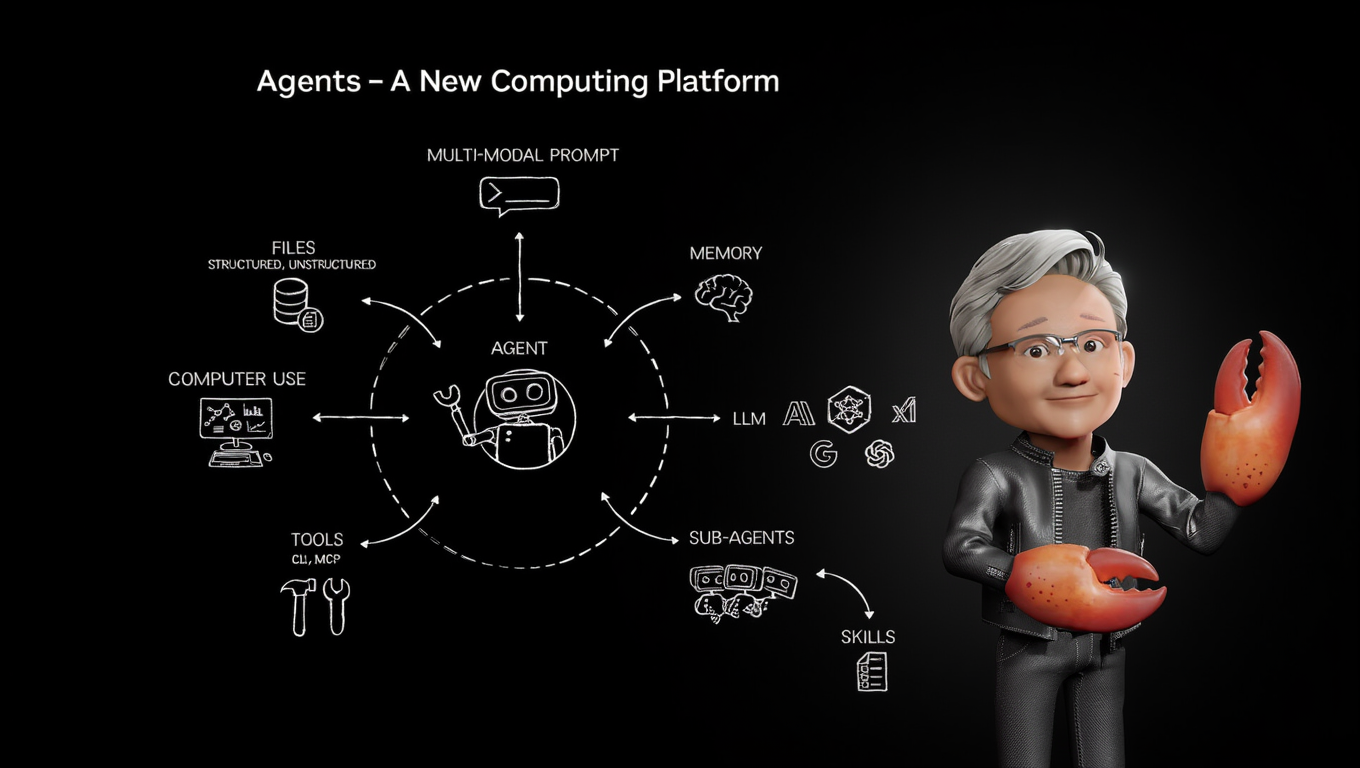
"Every company needs an OpenClaw strategy."
That's how NVIDIA CEO Jensen Huang opened GTC 2026 on March 16th. It wasn't just a catchy line from a keynote. It was the message that framed the entire event.
Huang compared OpenClaw to Linux and HTTP: standards that reshaped how entire industries operate. Companies that missed the Linux wave paid for it later. Those who ignored the web lost their markets.
In this article, we'll look at what OpenClaw is, what you can actually do with it, how it works, and what your business should be doing right now.
What Is OpenClaw?
OpenClaw is an open-source AI agent created by Peter Steinberger.
A typical chatbot gives you answers. OpenClaw executes tasks. It can send emails, manage calendars, run terminal commands, deploy code, and retain context across sessions.
OpenClaw has over 50 integrations, including email, calendars, browsers, code editors, databases, and file systems. It works with various large language models. You can use Claude, GPT, Gemini, Mistral, or local models.
Jensen Huang called OpenClaw "the operating system for intelligent computers." Just as Windows created a common platform for applications, OpenClaw aims to create a common platform for AI agents.
Popularity That's Hard to Ignore
OpenClaw reached 250,000 GitHub stars in less than four months. That growth isn't accidental.
Developers and businesses had been looking for a tool that goes beyond text responses — one that can perform real actions across different systems. OpenClaw answers exactly that need.
Steinberger recently joined OpenAI, but the OpenClaw project is moving under an open foundation. This should reduce dependency on any single company and strengthen the project's long-term sustainability.
What You Can Actually Do With OpenClaw
Theory is one thing. Value comes when an agent helps with real work. Here are some use cases that businesses can implement today.
Customer Service
A customer sends an email. The agent reads it, identifies the problem, searches the CRM for the customer's history, drafts a response, and sends it after approval.
The result is simple: your support agent doesn't spend 15 minutes searching for information. The AI agent handles most of the groundwork in seconds.
Sales Proposals
A sales manager says: "Create a proposal for company X." The agent researches the company, fills in the proposal template, adds a price calculation, and sends it for review.
This significantly reduces proposal preparation time and helps maintain consistent quality.
Weekly Reporting
Monday morning, the agent automatically compiles a sales report. It pulls data from the CRM and Google Sheets, creates a summary, and sends it to the team.
Nobody has to copy numbers manually or write summaries from scratch anymore.
IT Support
An employee reports: "The printer isn't working." The agent checks the device status, searches the knowledge base for a solution, and sends the employee instructions.
If the problem doesn't resolve, the agent automatically creates an IT ticket with initial diagnostics.
Contract Analysis
The agent reads a long contract, highlights risk areas, deadlines, and obligations, and creates a brief summary for the board.
It doesn't replace the lawyer, but it frees up their time from routine reading and initial summarization.
How OpenClaw Works
OpenClaw is not a black box. Here's a simplified view of the logic.
1. The agent runs on your machine or server. You control where the agent runs. If needed, nothing has to go to the cloud.
2. You connect a language model. Choose Claude, GPT, Gemini, Mistral, or a local model. The language model is the agent's decision layer — it understands the task and chooses next steps.
3. You grant access to tools. Email, calendar, files, CRM, Slack, databases. The agent can only use the tools you grant access to.
4. The agent gets a command and acts. You say what needs to be done. The agent breaks the task into steps, executes them in order, and asks for confirmation when needed. For example, "Draft a response to client X" might break down into: read the email, search CRM for client history, draft the response, ask for confirmation before sending.
5. MCP connects everything. Model Context Protocol (MCP) is the standard that connects the agent to your tools. A good analogy is USB: one universal way to connect very different devices and systems.
6. The agent remembers context. Context can persist across sessions. This means the agent doesn't have to start from scratch every time — it can continue where the previous work left off.
Why NVIDIA's Backing Matters
GTC 2026 wasn't just a product launch. NVIDIA positioned OpenClaw clearly as the platform for the next wave. Huang used three historical parallels.
Linux. In the 1990s, many companies were skeptical of an open-source operating system. Today, a large portion of the world's servers run on Linux. Those who started early gained a technical and business edge.
HTTP and HTML. Web protocols seemed interesting to a narrow audience at first. Later, all of today's commerce, media, and communication was built on top of them.
Windows. Microsoft didn't invent the computer. It created the platform that made computers useful for the mass market. OpenClaw aims to do something similar for AI agents: standardize how agents interact with tools, data, and users.
Huang also drew a parallel to Kubernetes — the platform that enabled cloud services and mobile apps to scale. In his words, every company in the world needs an OpenClaw strategy, just as they once needed a Linux strategy, a web strategy, and a cloud strategy.
NVIDIA's role here is significant because they don't just sell chips. They build AI infrastructure. When a company of that weight starts publicly backing a standard like OpenClaw, it sends a strong signal to the market.
And NVIDIA isn't alone. OpenAI launched Frontier in February — its own platform for enterprises to build and manage AI agents. Gartner's December report named AI agent governance platforms as the critical infrastructure companies need. When the biggest players are all moving into the same space, it confirms this is not a niche topic.
NemoClaw: A More Enterprise-Ready Layer
OpenClaw is powerful, but for enterprises, capability alone isn't enough. You also need security, control, and manageability. That's why NVIDIA built NemoClaw.
What Is NemoClaw?
NemoClaw is NVIDIA's enterprise solution that uses the OpenClaw core but adds security, privacy, and governance layers.
If OpenClaw is the engine, NemoClaw is the complete package — with protection mechanisms, management, and the reliability that a business actually needs.
An important detail: NemoClaw doesn't require NVIDIA hardware. The platform works with different devices and systems, which means a company doesn't need to replace its infrastructure to get started.
Security Layer
NemoClaw uses the OpenShell runtime — an isolated execution environment where the agent operates separately. This enables:
- Policy enforcement: you define what the agent can and cannot do. For example, it can read emails but cannot send anything without asking for confirmation.
- Network restrictions: the agent only accesses the systems and services you've approved.
- Privacy routing: sensitive data doesn't have to flow through third-party services.
- Audit logging: every agent action is traceable and reviewable.
Nemotron Models
NVIDIA also introduced the Nemotron model family, optimized for NemoClaw:
- Nemotron Nano is suited for simpler tasks like summaries and classification.
- Nemotron Super handles more complex workflows, analysis, and reporting.
- Nemotron Ultra is designed for the most demanding tasks like complex code generation or more autonomous decision logic.
NVIDIA also introduced the Nemotron Coalition, including partners like Cursor, LangChain, Mistral, Perplexity, and others. The goal is to build models better suited for agentic workflows.
Security Risks That Can't Be Ignored
It's important to be upfront: OpenClaw is not risk-free.
NVIDIA itself describes NemoClaw as an early-stage alpha release and warns developers to "expect rough edges." The product is moving toward production readiness, but it's still in its early stages.
An independent audit published in January 2026 found 512 vulnerabilities, 8 of which were critical. Several countries have raised the question of whether such agents should be used in sensitive environments.
This isn't surprising. An agent that can read emails, manage files, and execute commands is fundamentally different from a chatbot that just answers questions. If a chatbot makes a mistake, you get a bad answer. If an agent makes a mistake, it can take a wrong action.
That's precisely why you need restrictions, confirmation loops, logging, and isolated environments. The solution isn't to abandon agents entirely. The solution is to implement them with proper controls.
This is exactly how email, browsers, and cloud services evolved. There were plenty of security risks at first. Later, standards, protection layers, and best practices emerged. The same path lies ahead for AI agents.
What Companies Should Be Doing Right Now
The question is no longer just whether AI agents will become important. The question is where they create value in your business and how to adopt them safely.
Here are four practical steps.
1. Map Your Agent Readiness
Before choosing a tool, you need to understand where an agent actually creates value.
The best candidates are processes that are:
- Multi-step: require multiple sequential actions.
- Repetitive: happen every day or week in the same form.
- Dependent on manual steps: someone is waiting for approval, information, or a manual action.
Typical agent-ready processes in businesses:
- First-line customer service and routing
- Proposal and contract drafting
- Data collection and reporting
- Incoming invoice processing
- First-tier IT support
This is exactly where an AI audit delivers value. We map your processes, find high-impact use cases, and prioritize them by impact and complexity.
2. Start With a Controlled Environment
Don't give the agent full permissions right away. Start like this:
- The agent can read, but not send or delete.
- A human confirms critical actions.
- First use cases are internal and lower-risk.
NemoClaw makes this easier because policies and an isolated environment are built in. But the same principle applies even if you use a different solution: start small, verify results, expand gradually.
3. Choose a Deliberate Model Strategy
OpenClaw works with various language models. That means you have a choice:
- Cloud models (Claude, GPT, Gemini): quick start and excellent performance.
- Local or EU models (Nemotron, Mistral, Llama): more control over data, but requires more infrastructure.
If your company handles sensitive data (finance, healthcare, legal), take this choice seriously. Data protection isn't going anywhere, and the agent must fit your requirements — not the other way around.
Good news: with proper architecture, you don't have to lock yourself into one model forever.
4. Don't Just Research — Start
Companies that start earlier gain more than just a technical advantage. They get:
- Practical experience with use cases in their specific domain.
- Time to establish security policies and workflows.
- An edge over those still just discussing.
The same logic applies to agents. The difference is that an agent doesn't just help you write or search. An agent does work on your behalf. That means greater impact, but also greater responsibility.
How AI Eesti Can Help
You don't have to walk this path alone. AI Eesti helps companies implement AI agents so the solution creates real value — not just stays an experiment.
We map. We start with an AI audit — finding the processes and data where an agent delivers the greatest business impact. Not every workflow needs an agent. Our job is to identify which ones do.
We build. We connect the solution to your systems — CRM, email, Slack, databases — and configure the necessary restrictions. Everything needs to work together, not in silos.
We implement. We train your team, help get use cases working, and embed the solution into your actual work processes. The goal isn't a demo. The goal is a new way of working that sticks.
Summary
Three key conclusions from GTC 2026:
-
OpenClaw is moving toward becoming a standard. Strong developer interest, a rapidly growing ecosystem, and NVIDIA's firm backing suggest this isn't just another tool.
-
NemoClaw addresses the core enterprise challenge: control. The value of AI agents is significant, but without a security layer, policies, and traceability, they aren't ready for serious use.
-
Companies shouldn't wait for the perfect moment. The right next step isn't to do everything at once. The right next step is to map where an agent creates value, test in a controlled environment, and build from there.
Is your company ready for the age of AI agents?
AI Eesti helps you map where AI agents create real value in your business, build the right solution, and implement it so your team actually starts using it.