Mario Kadastik: Estonia's Next Digital Leap Requires AI Compute Power
 Mario Kadastik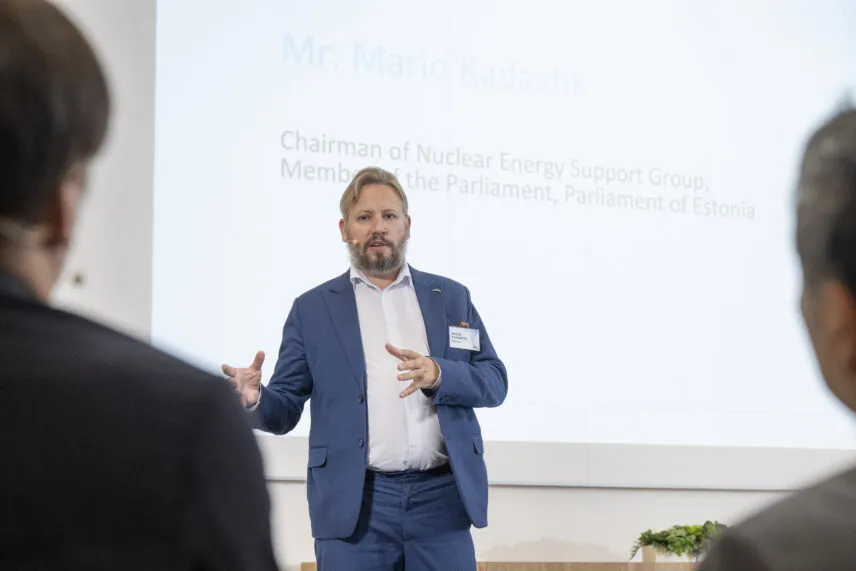
According to Riigikogu member and scientist Mario Kadastik, the arrival of AI factories would benefit all of Estonian society. Photo: private collection
Estonia has good prerequisites for AI adoption: a digital state, high-quality data, and a society accustomed to quickly embracing new solutions. There are ideas and ambition, but one critical component is missing: local AI compute power, argues Riigikogu member and scientist Mario Kadastik.
According to Kadastik, the central concern for AI development is that practically all large AI models currently reside either in the United States or China. "Europe has fallen behind in this race, mainly due to a lack of compute resources. When the necessary capability is on the other side of the world, startups and development move there too. This creates problems especially in areas that use sensitive or regulated data, such as health data," notes Kadastik.
Sensitive data cannot depend on foreign cloud services
Language models that can be trained using public data can successfully be trained in other countries' AI factories and used in Estonia, but the situation becomes more complex when sensitive personal data needs to be used for AI training.
"For example, a model trained on Asian or Latin American population health data would not have the desired effect in Estonia due to genetic differences. In such cases, there is a significant gap between training data and real data, which affects the model's reliability. That is why it is important that Estonia has AI training capability and that it is clear which data and under which legal framework models are being developed," explains Kadastik.
In Kadastik's view, AI could relieve family doctors of a large share of documentation and summary work. "If a doctor talks with a patient about their concerns during an appointment and AI creates a structured summary, the doctor would save significant time and could dedicate it to the patient. However, this would require an AI solution under state supervision, located locally or at least operating within the European legal framework, not a cloud service located outside our regulatory framework."
Estonia must have a sovereign part of a European AI factory
Europe needs its own AI factories, but investments in building complex infrastructure run into billions of euros. "The realistic solution is for a large international player to establish a data center here, with Estonia having a logically and legally separated, sovereign part. In terms of research funding, these sums are large, but in the context of an AI factory, they are relatively small. What matters is that Estonia owns a defined and clearly delineated share of the capability," says Kadastik.
Compute power close to data opens new possibilities
Discussing economic impacts, Kadastik believes that a major AI operator coming to Estonia would mean direct revenue for local businesses and create the conditions for new startups and services to emerge. "Right now, the major bottleneck for many projects is that data cannot be taken out of the country. When compute power is located close to the data, significantly more possibilities open up. Within the European Union, this topic is under discussion, and the question is how far privacy boundaries actually extend."
Although AI will not solve all the world's problems, many low-hanging fruits already exist. "Process optimization, documentation automation, self-driving vehicles, and logistics solutions. All of these reduce costs and increase flexibility. In addition, emergent effects will arise that we cannot yet foresee, meaning AI will start doing things through the interplay of various systems whose need or value we do not yet perceive," describes Kadastik.
AI factory and nuclear plant are natural partners
AI factories consume more electrical energy than traditional data centers, and while the lack of green energy may previously have hindered AI operators from coming to Estonia, that argument no longer holds. "In many European countries, it is no longer possible to add new large consumers to the grid, but in Estonia it is. At the same time, adding a large consumer to the grid means lower grid fees," explains Kadastik. "Stable large consumers create demand on the basis of which new production capacity can be built. This in turn gives investment certainty to energy producers."
As a proponent of nuclear energy, Kadastik sees AI factories as natural partners for nuclear plants. "An AI factory needs stable, round-the-clock electricity supply, and a nuclear plant needs a reliable and predictable consumer," he says. In Kadastik's view, the possibility of building an AI factory next to a future nuclear plant, with a direct power line, should be considered. The heat generated by the data center could be directed into the district heating network.
Kadastik concludes that the arrival of AI factories would benefit all of Estonian society. "The electricity market would become more stable, and the country's value proposition for international investors would grow. Additionally, AI factories bring a security dimension. If a US company owns strategic infrastructure in Estonia, their interest in ensuring regional stability increases. AI compute power also opens possibilities for defense applications, such as drone detection and interception."